Sip, Swirl, Savor: How the Olive Oil Tasting Movement Is Reshaping American Palates
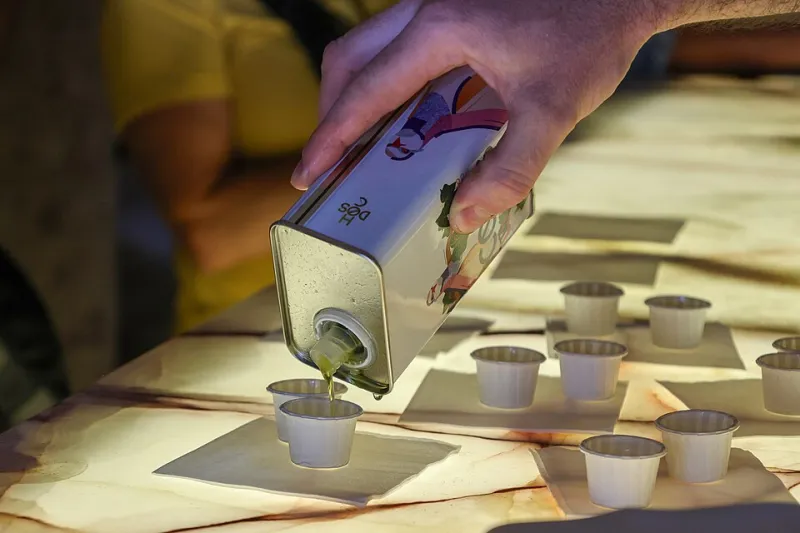
Photo: flowcomm, CC BY 2.0, via Wikimedia Commons
For decades, the average American kitchen treated olive oil as a largely undifferentiated commodity—something poured from a large tin without ceremony and replenished without thought. That relationship is changing. From specialty food shops in Portland to culinary studios in Charleston, a growing number of Americans are sitting down at tasting tables, raising small blue cobalt glasses to their lips, and discovering that olive oil is not merely an ingredient. It is a conversation.
This shift mirrors, in striking ways, the arc of American wine culture. In the 1970s and 1980s, wine was largely the province of specialists and European enthusiasts. Then came the educators, the tasting rooms, the sommelier programs, and an entire vocabulary that gave ordinary consumers permission to form opinions. Olive oil is now tracing a remarkably similar path—and the implications for the American table are profound.
The Blue Glass and the Trained Nose
Professional olive oil evaluation follows a protocol that would feel familiar to any wine lover. Tasters warm a small measure of oil in a cobalt-blue or dark glass—the color intentionally obscures the oil so that appearance does not bias perception—then inhale slowly before taking a careful sip. The experience is assessed across three primary attributes: fruitiness, bitterness, and pungency.
Fruitiness encompasses the aromatic richness of the oil, ranging from ripe, buttery notes in late-harvest varieties to the vivid green herbaceousness of early-harvest oils. Bitterness, often misunderstood by newcomers, is not a flaw but a marker of polyphenol content—those beneficial antioxidants that distinguish premium extra-virgin oil from lesser grades. Pungency, that characteristic peppery finish that catches at the back of the throat, is similarly prized; it signals the presence of oleocanthal, a compound with well-documented anti-inflammatory properties.
The International Olive Council has formalized this methodology, and certified tasting panels worldwide use it to determine whether an oil meets the legal standard for extra-virgin classification. In the United States, the Olive Oil Sommelier Certification program and similar offerings through institutions such as the Culinary Institute of America have brought this framework to aspiring professionals and dedicated enthusiasts alike.
Terroir Comes to the Oil Aisle
One of the most intellectually satisfying developments in the American olive oil conversation is the growing appreciation for terroir—that French concept, borrowed gratefully from wine culture, which acknowledges that the land, climate, elevation, and farming practices of a specific place imprint themselves unmistakably on the final product.
An arbequina grown in the coastal hills of California will taste meaningfully different from one pressed in Catalonia, even if the olive variety is nominally identical. Soil composition, rainfall patterns, the timing of harvest, and the hours elapsed between picking and pressing all contribute to a flavor signature as individual as a fingerprint. American consumers who have begun to explore single-estate and single-variety oils are discovering this firsthand—and finding it every bit as compelling as the notion of a Burgundy vineyard expressing its particular patch of limestone.
This awareness is being actively cultivated by a new generation of retailers and educators. Specialty food stores in cities such as San Francisco, Chicago, and New York now host structured tasting events where participants move through flights of oils from different regions and varietals, much as a wine bar might present a comparative tasting of Rieslings from Alsace, the Mosel, and the Clare Valley.
How to Taste Olive Oil Like a Professional
For those ready to move beyond casual appreciation, the professional tasting method is readily accessible at home. Begin by selecting three to five extra-virgin olive oils of differing origins and harvest dates—ideally including at least one early-harvest variety for contrast. Pour a small measure, roughly a tablespoon, into a wine glass or any vessel you can cup in your hands.
Warm the glass gently between your palms for thirty seconds, then cover it and swirl. When you lift the cover and inhale, take a slow, deliberate breath and note the first impressions: Do you detect cut grass, green tomato, artichoke, or fresh herbs? Or does the oil lean toward ripe fruit, almond, or a softer, more buttery character?
Next, take a small sip and draw a thin stream of air across it—a technique called strippaggio in Italian—which volatilizes the aromatic compounds and intensifies the experience. Allow the oil to coat your palate fully before swallowing, and pay attention to what happens in the moments that follow. A quality extra-virgin oil will often deliver a delayed peppery sensation at the back of the throat; two or three distinct coughs are, among professionals, considered a mark of distinction rather than discomfort.
Finally, evaluate finish and balance. Does any single attribute overwhelm the others, or do fruitiness, bitterness, and pungency resolve into something coherent and pleasing? Balance, in olive oil as in wine, is the hallmark of genuine quality.
From Tasting Table to Everyday Practice
The practical reward of developing an educated palate is not merely the pleasure of a more nuanced experience—it is the ability to make better decisions at the point of purchase and, crucially, to deploy the right oil for the right purpose in the kitchen.
A robust, intensely peppery Sicilian nocellara may overwhelm a delicate crudo but will stand magnificently against a Tuscan ribollita or a plate of grilled lamb. A mild, buttery California mission oil might be the precise choice for finishing a bowl of chilled cucumber soup or drizzling over vanilla gelato. These are not arbitrary preferences; they are the natural conclusions of a palate that has been given the tools to listen.
At Glassolive, we believe that the best olive oil is the one you understand well enough to use with intention. The tasting movement sweeping American food culture is not a trend in the dismissive sense of the word. It is an education—one that rewards patience, curiosity, and a willingness to slow down and pay attention. The liquid gold in your pantry has a great deal to say. The question is simply whether you are ready to hear it.