Finding Your Flavor Language: How to Build a Personal Olive Oil Tasting Vocabulary
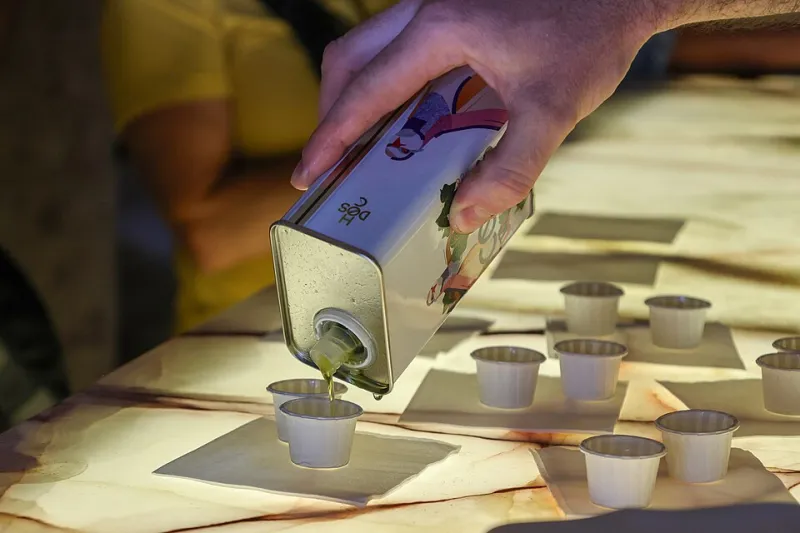
Photo: flowcomm, CC BY 2.0, via Wikimedia Commons
For decades, the American dinner table has deferred to wine culture when it comes to the art of flavor description. Sommeliers have trained us to speak in tasting notes—to identify blackcurrant on a Cabernet or wet slate on a Chablis—and we have largely accepted that this level of discernment belongs to the grape. Yet olive oil, that ancient and irreplaceable cornerstone of fine cooking, has long deserved the same rigorous attention. A growing community of American food enthusiasts, chefs, and specialty retailers is now proving that point, developing a sophisticated sensory lexicon that stands entirely on its own.
At Glassolive, we believe that understanding what is in your bottle is inseparable from knowing how to use it well. The first step toward that understanding is language.
Why Olive Oil Vocabulary Has Lagged Behind Wine
The disparity is, in many ways, a matter of cultural exposure. Wine tasting has been institutionalized in the United States through certification programs, restaurant culture, and decades of media coverage. Olive oil, by contrast, has too often been treated as a commodity—something purchased in bulk, stored indefinitely, and used interchangeably regardless of variety or origin.
This perception is changing. As American consumers increasingly seek out single-origin, estate-pressed, and harvest-dated oils, they are encountering flavors that resist simple description. An Arbequina from California's Central Valley tastes nothing like a Koroneiki from the Peloponnese, and neither resembles a Taggiasca from Liguria. Capturing those differences requires vocabulary—and vocabulary requires practice.
The Science of What You Are Actually Tasting
Before reaching for descriptors, it helps to understand what your palate is actually detecting. Extra virgin olive oil contains hundreds of volatile aromatic compounds, polyphenols, and fatty acids, all of which contribute to its sensory profile. Professional tasters evaluate oil across three primary dimensions:
Fruitiness refers to the aromatic complexity derived from the olive fruit itself. Green fruitiness—evoking fresh-cut grass, artichoke, green tomato, or unripe banana—indicates early-harvest oils pressed from olives that have not yet fully ripened. Ripe fruitiness, by contrast, suggests warmer, rounder notes: dried fruit, almond, ripe apple, or even a subtle sweetness.
Bitterness is a positive attribute in quality olive oil, produced by phenolic compounds called oleuropein and related molecules. A pronounced bitterness on the back of the tongue often signals high polyphenol content and, by extension, freshness and health-promoting properties.
Pungency, the peppery sensation that catches in the throat, is caused primarily by oleocanthal—a compound with documented anti-inflammatory properties. Far from being a flaw, this characteristic sting is a marker of quality that tasters actively seek.
Beyond these three pillars, trained evaluators also identify defects: rancidity (the result of oxidation), mustiness (from improper storage of the olive fruit), and winey or vinegary notes (caused by fermentation). Knowing defects is as important as knowing virtues; it calibrates the palate against what oil should never taste like.
The Tasting Wheel: A Map for the Curious Palate
The International Olive Council (IOC) and various academic institutions have developed tasting wheel frameworks that organize olive oil descriptors into logical clusters. While these tools were designed for professional panel use, they are genuinely accessible to the enthusiastic home taster.
The wheel typically radiates outward from broad categories—fruity, bitter, pungent—into increasingly specific sub-descriptors. Under the green fruit category, for example, you might find: fresh herb, green almond, artichoke, tomato leaf, and freshly mown grass. Under the ripe fruit branch: butter, dried fruit, tropical note, and sweet almond.
Using the wheel is not about memorizing a list. It is about giving yourself permission to be specific. When you taste an oil and notice something vegetal, pause and ask: is it more like raw artichoke, or closer to fresh basil? Is that bitterness immediate and sharp, or does it arrive slowly at the back of the palate? That level of attention transforms tasting from a passive act into an active inquiry.
Practical Exercises to Sharpen Your Palate
Building a tasting vocabulary is a cumulative process. These exercises, practiced consistently, will accelerate your development considerably.
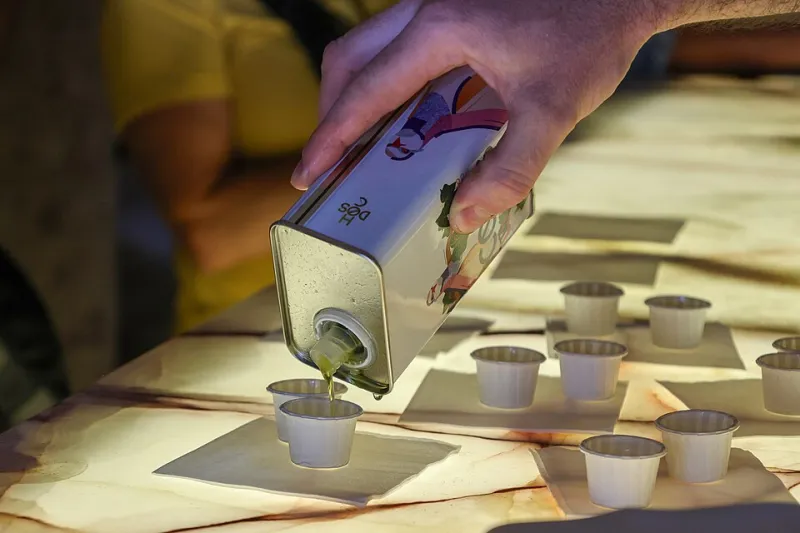
The Blue Glass Exercise: Professional tasters in IOC-certified panels use cobalt blue glasses to eliminate visual bias—color can suggest quality where none exists, or obscure it where it does. At home, you can approximate this by tasting blind. Pour oils into identical, unlabeled vessels and evaluate them without any prior knowledge of origin or variety.
The Side-by-Side Comparison: Select two oils from different regions or olive varieties and taste them within minutes of each other. The contrast sharpens perception dramatically. You will notice differences you would never detect tasting a single oil in isolation.
The Warm Cup Method: Gently warm a small amount of oil in your palm by cupping your hands around the vessel for thirty to sixty seconds. Warmth releases volatile aromatics, making the oil's character more legible. Inhale deeply before tasting.
Anchor Your Memory: Smell real-world reference points—a cut artichoke, fresh-picked basil, a green tomato, a handful of raw almonds—before your tasting session. These olfactory anchors make it far easier to recognize corresponding notes in the oil.
Keep a Tasting Journal: Document every oil you try, noting producer, variety, harvest date, and your observations across fruitiness, bitterness, and pungency. Over time, patterns emerge. You will begin to recognize the signature of a particular region or producer the way a seasoned reader recognizes an author's prose style.
Moving Beyond Borrowed Language
One of the most liberating aspects of developing a genuine olive oil vocabulary is the freedom it offers from wine-centric comparisons. Olive oil does not need to be described as the wine of the kitchen to deserve serious attention. Its sensory universe is distinct—rooted in the Mediterranean landscape, in the specific character of individual olive cultivars, in the decisions made during harvest and pressing.
When you taste an oil and find yourself reaching for a phrase that genuinely captures what you are experiencing—when you can say, with confidence, that a particular Picual carries a bold green tomato note with a long, peppery finish and almost no rancid drift—you have arrived at something meaningful. You are no longer a passive consumer of a pantry staple. You are a participant in one of the oldest and most refined culinary traditions in human history.
At Glassolive, that kind of informed engagement is precisely what we hope every bottle inspires.