The New Dinner Party Centerpiece: Orchestrating a Formal Olive Oil Tasting for Your Guests
For generations, the American dinner party followed a familiar script: guests arrive, wine is poured, conversation flows, and the meal proceeds. That script, however, is being quietly rewritten. In kitchens from Portland to Charleston, a growing number of hosts are introducing something unexpected before the first course ever arrives—a formal olive oil tasting, structured with the same care and ceremony once reserved exclusively for fine wine.
The impulse is not merely fashionable. It reflects a deeper shift in how discerning Americans are thinking about food culture, provenance, and the pleasures of slowing down long enough to actually taste what is on the table.
Why Olive Oil Lends Itself So Naturally to Ceremony
Wine has long benefited from the theater of service: the presentation of the bottle, the pour, the swirl, the evaluation. What many enthusiasts are discovering is that premium olive oil offers an equally rich sensory landscape—one that most guests have never been invited to explore deliberately.
A well-made extra virgin olive oil carries genuine complexity. Depending on the cultivar, the harvest date, and the region of origin, a single oil might offer green tomato leaf on the nose, a mid-palate richness reminiscent of ripe stone fruit, and a finish that arrives as a clean, peppery catch at the back of the throat—the hallmark of high polyphenol content. These are not abstract qualities. They are perceptible, discussable, and deeply enjoyable to discover in company.
The tasting ceremony creates a shared vocabulary for that discovery. It transforms passive consumption into active engagement, and it gives guests a reason to be curious before the evening's first formal course.
Designing the Tasting Flight
The most successful olive oil tastings follow a principle borrowed directly from wine service: move from delicate to bold, from mild to assertive. Beginning with a light, buttery oil—perhaps a Ligurian-style Taggiasca or a domestic Arbequina from California's Central Valley—allows guests to calibrate their palates before encountering more assertive expressions.
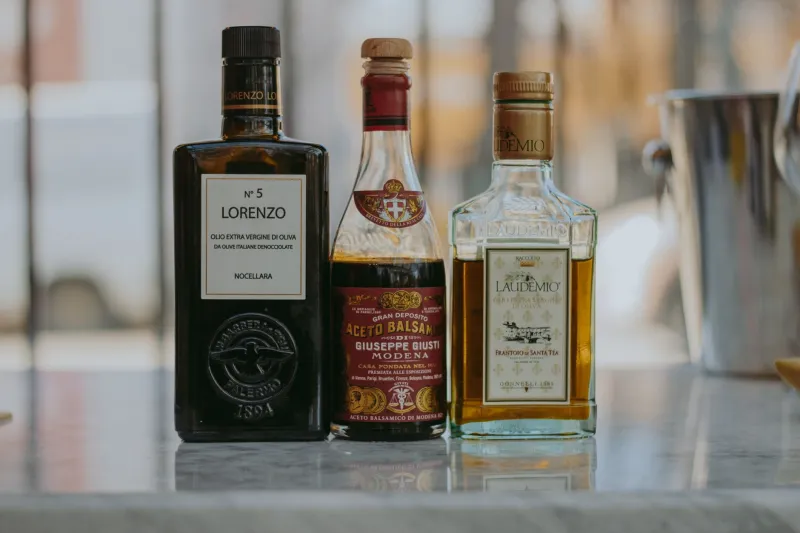
A well-constructed flight of three to five oils is ideal for a dinner party context. Consider organizing selections around a single theme: a vertical comparison of harvest years from the same producer, a horizontal tasting of the same cultivar grown in different regions, or a curated journey across countries such as Spain, Greece, and Italy alongside a domestic American option. Each approach tells a different story, and the host's role is to serve as narrator.
Present each oil in a small ceramic cup or a traditional blue cobalt tasting vessel—blue glass is used professionally because it removes color bias, preventing the eye from making assumptions the palate should make independently. Serve oils at room temperature, ideally between 65 and 70 degrees Fahrenheit, which allows volatile aromatic compounds to express themselves fully without the distortion that refrigerator-cold temperatures can introduce.
The Role of the Palate Cleanser
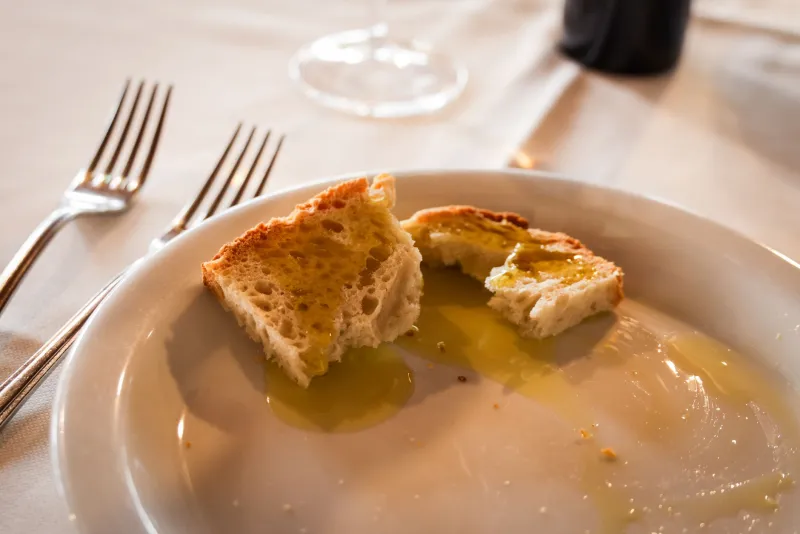
This is where the olive oil tasting ritual diverges most meaningfully from wine. Rather than water alone, experienced hosts offer sparkling water alongside thin slices of plain, unsalted bread—specifically chosen to neutralize the palate rather than introduce competing flavors. Green apple slices serve a similar function and add a subtle elegance to the presentation.
Some hosts go further, offering a small piece of high-quality dark chocolate between oils. The bitterness of good chocolate performs a reset function on the palate, and the pairing also opens a natural conversation about how olive oil's own pleasant bitterness—derived from oleocanthal and other polyphenols—relates to flavor rather than defect. This is often a revelatory moment for guests who have spent years assuming that any bitterness in oil signals spoilage.
Instruct guests to resist the urge to dip bread into every oil from the outset. The first evaluation of each oil should be taken neat—a small sip drawn through slightly pursed lips, the same technique used by professional tasters, which aerates the oil and distributes it across the full palate. The bread comes after, as a secondary reference point.
Guiding Guests Through the Evaluation
Not every guest will arrive with a tasting vocabulary, and that is precisely the point. The dinner party tasting is an educational experience as much as a sensory one, and the host's job is to offer gentle structure without academic rigidity.
Prepare a simple printed card for each place setting—nothing elaborate, but something that prompts guests to consider three dimensions: aroma, taste, and finish. Under aroma, offer a short list of descriptors to choose from: fresh-cut grass, green herb, ripe fruit, floral, nutty. Under taste, suggest: buttery, grassy, peppery, mild, robust. Under finish, ask simply: how long does the sensation linger, and where do you feel it?
The conversation that emerges from these prompts is invariably lively. Disagreement is welcome—professional tasters rarely reach identical conclusions—and the act of articulating a sensory impression, however tentative, deepens the experience for everyone at the table.
The Psychology of Slowing Down
There is something worth acknowledging about what a structured tasting actually does to the rhythm of a dinner party. It introduces a pause. In an era of distracted, hurried eating, the ceremony of evaluation asks guests to be fully present—to set down their phones, to close their eyes for a moment, to attend to something subtle.
Hosts who have incorporated olive oil tastings into their entertaining consistently report that the ritual changes the energy of the evening. Guests arrive at the dinner table already engaged, already talking, already connected to the food and to one another in a way that a conventional cocktail hour rarely achieves. The tasting functions as a social warm-up, a shared act of attention that primes the group for the meal ahead.
Practical Considerations for the Host
A few logistical points will save considerable effort on the evening itself. Label each oil clearly with its name, origin, and harvest date—these details anchor the conversation and allow guests to return to a bottle they particularly enjoyed. Source oils from a trusted purveyor who can speak to provenance and freshness; an oil that is past its peak will undermine the entire experience regardless of how elegantly it is presented.
Keep the flight manageable. Three oils is sufficient for guests new to the practice; five is appropriate for a more experienced group. Beyond five, palate fatigue tends to flatten the distinctions between samples, diminishing rather than enhancing the experience.
Finally, consider how the tasting connects to the meal that follows. If the evening's main course features a bold, herb-crusted lamb, introduce a peppery Coratina or a robust Koroneiki early in the flight so guests arrive at the table already primed for that flavor register. The tasting and the dinner, at their best, form a single continuous conversation.
An Invitation Worth Extending
The olive oil tasting ceremony is, at its core, an act of generosity—an invitation to guests to pay closer attention to something they encounter every day. It asks very little of them and returns quite a lot: genuine discovery, lively conversation, and the particular pleasure of understanding, for the first time, that what they once thought of as a pantry staple is, in fact, a subject worthy of serious and joyful attention.
For the host willing to invest in a few well-chosen bottles and an hour of preparation, the return is an evening that guests will discuss long after the plates have been cleared.