The Art of the Second Pour: How Layering Olive Oils Transforms a Dish From Simple to Sublime
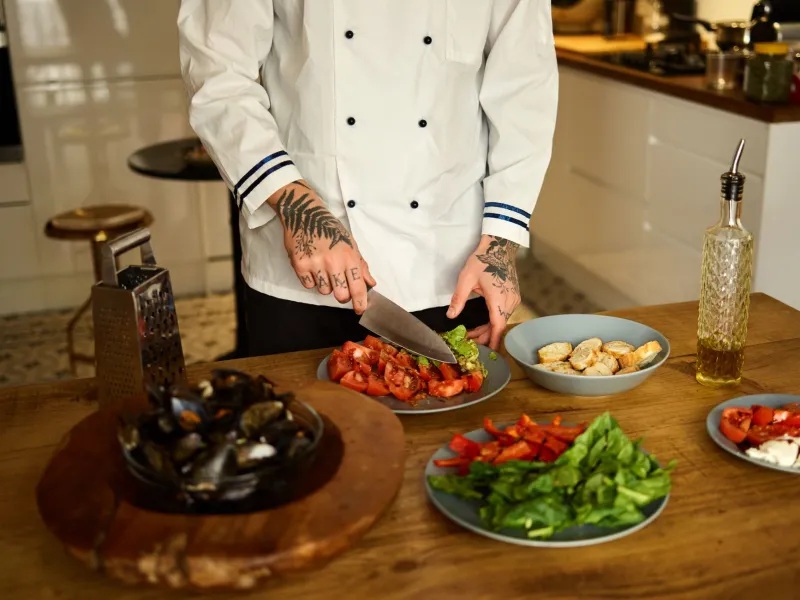
There is a moment in the kitchen that most home cooks overlook entirely: the finish. The dish is plated, the heat is off, and a final drizzle of olive oil is added almost as an afterthought — a habit rather than a decision. Yet for those who have studied the craft of serious cooking, that final pour is not a footnote. It is a signature. And when it is paired with a deliberate first pour, and perhaps a third along the way, something extraordinary begins to happen.
Olive oil layering — the practice of using two or more distinct oils at different stages of preparation — is among the most accessible and least discussed techniques in contemporary American cuisine. It borrows its logic from the world of wine pairing, where the goal is not simply to find one good match, but to build a conversation between food and liquid that evolves through the course of a meal. Applied to cooking, the same principle suggests that a robust Sicilian oil used to sauté aromatics will tell an entirely different story than a delicate Ligurian oil whispered across the finished plate. Together, they tell something neither could articulate alone.
Why One Oil Is Rarely Enough
The misconception that a single high-quality olive oil should handle every task in the kitchen is understandable. Premium oil is an investment, and the instinct to simplify is natural. But olive oil is not a monolithic ingredient. A high-polyphenol, early-harvest Tuscan oil carries grassy bitterness and a peppery finish that performs brilliantly as a flavor-forward drizzle — yet that same assertiveness can overwhelm delicate proteins if used as the sole cooking medium. Conversely, a mild, buttery Arbequina from California's Central Valley is a generous and forgiving base for sautéing, but it lacks the aromatic punch needed to lift a finished bowl of soup or a plate of grilled vegetables.
The solution is not to compromise. It is to specialize.
Think of your pantry as a small orchestra. Each oil occupies its own register. The layering technique is simply the act of conducting them in sequence.
The Three-Stage Framework
For practical purposes, olive oil layering can be organized around three distinct culinary moments, each calling for a different type of oil.
Stage One: The Foundation Pour
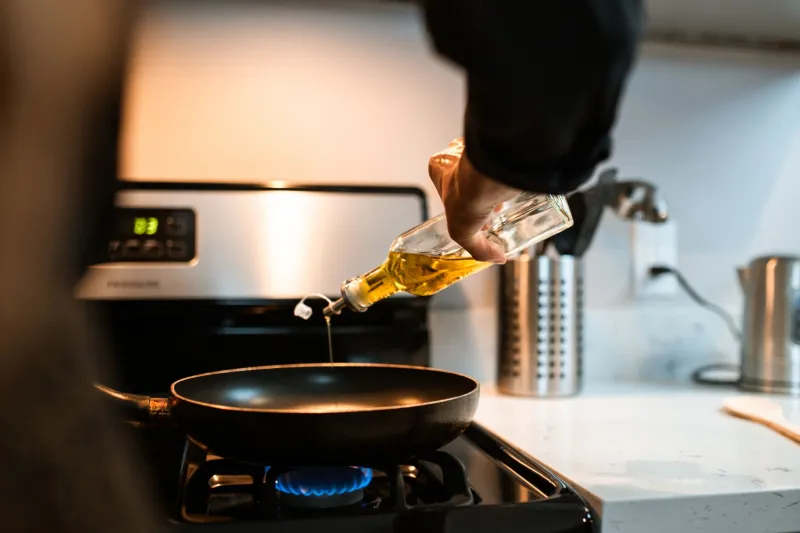
This is the cooking oil — the medium through which aromatics are softened, proteins are seared, and vegetables are coaxed into tenderness. At this stage, heat is the primary variable. You want an oil that can withstand moderate temperatures without degrading, while still contributing a baseline of flavor. A medium-intensity oil with good stability is ideal here: a Koroneiki-dominant Greek blend, a domestic Californian Arbequina, or a well-made Spanish Hojiblanca will all perform admirably. The goal is not spectacle. It is structure.
Stage Two: The Mid-Cook Integration
This stage is the most frequently skipped, and the most revelatory once discovered. At the point when a braise is deepening, a sauce is reducing, or a grain dish is nearly finished, a second oil can be introduced to add a new aromatic dimension. This is the moment to introduce something with more character — a Provençal oil carrying herbal notes, a Sicilian blend with a hint of tomato-leaf brightness, or a Spanish Picual with its distinctive olive-forward intensity. Because this oil is added to a warm (but not searing) environment, it blooms without burning, releasing volatile aromatic compounds that fuse with the developing flavors of the dish.
Stage Three: The Finishing Pour
This is where many cooks begin and end their relationship with premium olive oil — and rightly so, because the finishing pour is transformative. Applied to a plated dish, a high-quality finishing oil functions as a flavor amplifier, a textural element, and an aromatic signal all at once. Here, you want your most expressive, most polyphenol-rich oil: an early-harvest Frantoio from Tuscany, a robust Coratina from Puglia, or a peppery California estate oil that delivers that characteristic catch at the back of the throat. This is not background music. This is the soloist.
Putting the Technique to Work: A Practical Example
Consider a simple white bean and kale soup — a dish that many American home cooks prepare weekly without giving much thought to its potential for complexity.
Begin by warming a mild, buttery Arbequina in a heavy-bottomed pot over medium heat. Add diced onion, celery, and garlic, allowing them to soften slowly. The Arbequina carries enough flavor to contribute without competing with the vegetables. Once the aromatics are translucent, add the beans, stock, and kale. As the soup approaches its final simmer and the kale has wilted into the broth, stir in a small measure of a Spanish Picual — its robust, slightly bitter character will deepen the savory backbone of the dish in a way that the Arbequina cannot.
When the bowl reaches the table, finish with a generous pour of a peppery Tuscan Frantoio. Watch the oil pool briefly across the surface before breaking into rivulets. The aroma that rises from that bowl — the grassy, slightly pungent perfume of a fresh-pressed oil meeting warm broth — is the moment the technique announces itself. The soup that might have been pleasant becomes memorable.
Selecting Your Oils With Intention
The layering technique demands a pantry stocked with at least two or three oils that occupy meaningfully different flavor positions. The temptation to purchase a single "do-everything" oil is worth resisting. Instead, consider organizing your selection along a simple axis: mild to robust.
A mild oil (low polyphenols, gentle flavor) should anchor your collection as the everyday cooking base. A medium-intensity oil serves as the transitional element, suitable for mid-cook additions and light finishing applications. A robust, high-polyphenol oil — ideally from a recent harvest with a clearly marked pressing date — earns its place as the finishing oil, reserved for moments when its character will be most perceptible.
For American cooks, domestic California producers offer exceptional range across this spectrum, with many estates now producing single-varietal oils that make flavor comparisons straightforward. European imports from Greece, Italy, and Spain fill in additional flavor profiles that domestic production does not yet fully replicate.
The Deeper Principle
What the layering technique ultimately teaches is that cooking is a temporal art. Flavor is not deposited all at once; it accumulates across time and temperature, each addition leaving its trace in the developing whole. Olive oil, with its remarkable range of aromatic compounds, is uniquely suited to this kind of staged contribution.
The parallels to wine service are not merely decorative. Just as a sommelier might recommend different wines across the courses of a meal — a crisp Chablis with oysters, a structured Burgundy with the entrée, a late-harvest Riesling with dessert — the attentive cook can choreograph a progression of olive oils that guides the palate through a dish's full arc.
It requires only two things: a willingness to invest in more than one bottle, and the discipline to pause and ask, at each stage of cooking, which oil belongs here.
The answer, once you begin asking, is almost always more interesting than you expected.