Heat, Time, and Precision: The Science Behind Cooking With Premium Olive Oil
For years, a quiet orthodoxy has governed the American home kitchen: reserve the good olive oil for finishing, and reach for something cheaper when the burner comes on. It is advice passed along by well-meaning food writers, echoed in cooking classes, and printed on countless recipe cards. It is also, in large measure, incomplete — and occasionally wrong.
The science of cooking with premium olive oil is richer and more nuanced than a single smoke point number can convey. When you understand what actually happens to oil as it heats, how its polyphenols behave under stress, and why emulsification responds to temperature in predictable ways, you are no longer guessing. You are cooking with intention.
What the Smoke Point Number Actually Tells You — and What It Doesn't
The smoke point of an oil is the temperature at which it begins to visibly smoke and break down, releasing acrolein and other volatile compounds. For extra virgin olive oil, that figure is commonly cited somewhere between 375°F and 405°F, depending on the oil's acidity, polyphenol content, and age. High-quality, low-acidity extra virgin olive oils consistently test toward the upper end of that range — often higher than refined vegetable oils that are frequently marketed as superior cooking fats.
What the smoke point does not tell you is the full story of flavor degradation. An oil can begin losing its more volatile aromatic compounds — the grassy, peppery, and fruity notes that define a fine extra virgin — well before it reaches the smoking threshold. This matters enormously if your goal is to preserve the character of a prized single-estate oil in the finished dish. It matters far less if the oil is functioning as a cooking medium for a long braise or a deeply caramelized soffritto, where those delicate volatiles were never going to survive regardless of which fat you used.
The practical takeaway: matching your oil to the role it plays in a given technique is more meaningful than memorizing a single temperature figure.
Sautéing, Roasting, and the Case for Cooking With Quality Oil
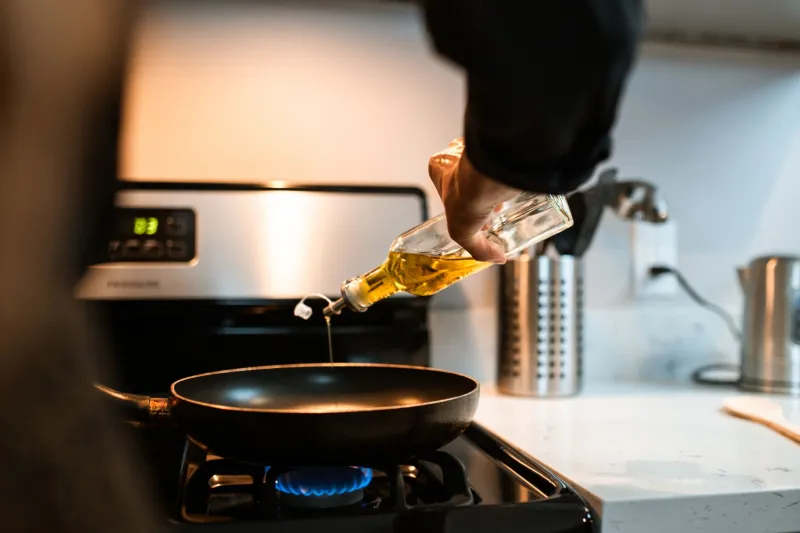
Consider what happens when you sauté aromatics — shallots, garlic, a tangle of leeks — in extra virgin olive oil over moderate heat. The oil is not merely a lubricant preventing sticking. It is a carrier for fat-soluble flavor compounds from the aromatics themselves, drawing them out and distributing them through the dish. The minor phenolic compounds in the olive oil interact with those released by the vegetables, building a foundation of flavor that a neutral oil simply cannot replicate.
Roasting follows similar logic. When vegetables or proteins are finished in an oven at 375°F to 425°F, the oil coating their surface is exposed to heat in a thin layer with significant air contact. Oxidation occurs, but in a controlled and culinarily productive way — the Maillard reactions responsible for browning depend partly on the oil's behavior at the surface. A robust, high-polyphenol extra virgin olive oil holds up admirably here, and contributes a depth that refined oils lack.
For everyday sautéing and roasting, a well-made, fresh extra virgin olive oil — one you trust for quality but that may not be your most precious single-estate bottle — is genuinely the right tool. Reserve the extraordinary for where extraordinary is perceptible.
The Polyphenol Question: Heat as Both Enemy and Ally
Polyphenols are the bioactive compounds responsible for much of olive oil's peppery finish and its widely studied health profile. They are also heat-sensitive, and their degradation under prolonged or extreme temperatures is well-documented. A long, high-heat application will reduce polyphenol concentration meaningfully.
However, context matters. Research published in food science literature has shown that when olive oil is used in cooking acidic or water-containing preparations — a tomato sauce, a lemon-dressed pan sauce, a vegetable braise — polyphenols can transfer into the food itself, partially preserving their presence in the final dish. The oil does not simply lose its beneficial compounds into the air; some migrate into the ingredients it surrounds.
For the home cook, this means that even when you cook with premium olive oil rather than finishing with it, you are not necessarily squandering its virtues. You are redistributing them.
Emulsification: Where Temperature Becomes a Tool
One of olive oil's most underappreciated roles in the kitchen is as an emulsifier — or more precisely, as a participant in emulsification. Classic vinaigrettes, pan sauces finished with a drizzle of oil, and the celebrated pasta technique known as mantecatura all depend on olive oil's ability to form stable, cohesive emulsions with water-based liquids.
Temperature is critical to this process. A warm pan sauce will accept olive oil more readily than a cold one, because the reduced viscosity of the oil at moderate warmth allows it to disperse into smaller droplets. Pasta cooking water — starchy, hot, and slightly alkaline — creates an ideal environment for olive oil to emulsify into a silky, coating sauce when the pan is kept at a gentle simmer and the oil is added gradually with motion.
Conversely, adding cold oil to a too-hot pan causes rapid separation rather than integration. The technique of gently warming olive oil before incorporating it into a sauce is not culinary affectation; it reflects a real and reproducible physical principle.
When Finishing Oil Is the Right Answer — and Why
None of this is an argument against finishing with premium olive oil. On the contrary: understanding when heat helps and when it harms makes the finishing drizzle a far more deliberate and effective choice.
A spoonful of a vivid, freshly pressed extra virgin — its volatile aromatics still intact, its polyphenols undisturbed — applied to a bowl of warm soup, a plate of simply grilled fish, or a wedge of good bread just before serving is an act of precision. You are delivering flavor compounds directly to the palate without the attenuation that heat would impose. The grassiness, the pepper, the fruit: all present and fully expressive.
The discipline lies in knowing which moment calls for which approach. A gentle warm application — say, blooming dried herbs in olive oil at low heat before adding them to a dish — can unlock oil-soluble aromatic compounds in those herbs while preserving much of the oil's own character. A high-heat sear is a different matter entirely.
A Framework for the Intentional Cook
Rather than following a single rule about olive oil and heat, consider adopting a three-part framework:
Function first. Ask what role the oil is playing — cooking medium, emulsifier, or finishing element. Each role has different temperature requirements and tolerances.
Quality in proportion to perceptibility. The more directly the oil's flavor will register on the palate — unmediated by long cooking or strong competing ingredients — the more it justifies using your finest bottle.
Freshness as a constant priority. No technique compensates for oil that is old, oxidized, or poorly stored. A fresh, well-made extra virgin olive oil of modest price will outperform a prestigious but degraded one in every application.
The American kitchen has long been underserved by oversimplified guidance on this subject. Premium olive oil is not a fragile luxury to be shielded from heat; it is a complex, capable ingredient whose behavior under different conditions rewards study. The cook who understands those conditions doesn't just protect an investment — they cook more beautifully because of it.