Where Heat Meets Flavor: Rethinking Temperature Thresholds for Premium Olive Oil in the American Kitchen
Ask almost any American home cook why they reach for a neutral oil when searing a steak or roasting vegetables at high heat, and the answer arrives with practiced certainty: olive oil burns. The smoke point mythology has been repeated so thoroughly, across so many cooking shows, food blogs, and kitchen conversations, that it has hardened into received wisdom. The problem is that it is only partially true—and the parts it omits are precisely where premium olive oil becomes most interesting.
At Glassolive, we believe that understanding what heat actually does to fine olive oil, at each specific temperature threshold, is not a technical footnote. It is the difference between cooking with intention and cooking by reflex.
The Smoke Point Is a Threshold, Not the Whole Story
The smoke point of extra virgin olive oil is typically cited somewhere between 375°F and 410°F, depending on the source. That range already hints at the first problem: smoke point is not a fixed property. It varies significantly based on the oil's free fatty acid content, polyphenol concentration, filtration level, and freshness. A robust, freshly harvested Sicilian Nocellara with a high polyphenol count will behave very differently under heat than a delicate, buttery Arbequina from California's Central Valley.
More importantly, smoke point measures one thing only: the temperature at which an oil begins producing visible smoke. It says nothing about what has already happened to the flavor, the aromatics, or the beneficial compounds at temperatures well below that threshold.
The real story begins much earlier.
What Happens Below 300°F: The Flavor Preservation Zone
At temperatures between roughly 200°F and 300°F—the range covering gentle sautéing, softening aromatics, and low-heat infusions—premium olive oil is largely in its element. The volatile aromatic compounds that define a great oil's character, the grassy top notes, the peppery finish, the faint almond or artichoke nuances, remain largely intact. This is the zone where olive oil does not merely serve as a cooking medium; it actively contributes flavor to a dish.
For American home cooks, this translates directly to technique. Sweating onions and garlic in a generous pour of high-quality extra virgin olive oil at low-to-medium heat is not a compromise. It is an opportunity. The oil carries those flavors into the fat-soluble compounds of the aromatics, building a foundation that a neutral oil simply cannot replicate.
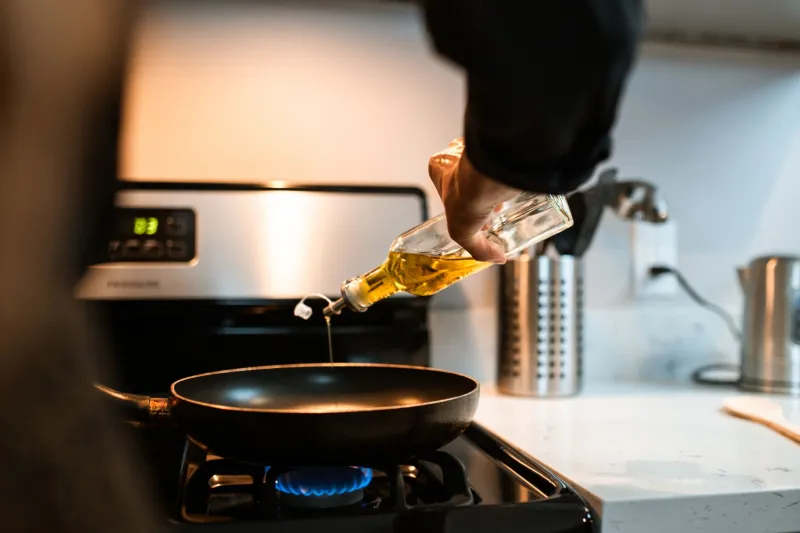
The practical instruction here is straightforward: resist the instinct to rush. A wider pan at lower heat, with a quality extra virgin olive oil, will yield a more flavorful result than a hot pan with a refined oil, particularly in dishes where the cooking fat is meant to be tasted.
The 300°F to 375°F Window: Where Precision Separates Good from Great
This is the most consequential temperature range for everyday cooking, and it is also the most misunderstood. Between 300°F and the oil's individual smoke point, meaningful chemical changes are occurring—but they are not uniformly destructive.
Certain volatile compounds do begin to dissipate in this range, which is why finishing an already-hot dish with a drizzle of premium olive oil will always deliver more aromatic intensity than incorporating the same oil at the start of a long braise. However, the polyphenols and oleic acid that give extra virgin olive oil its nutritional and structural character are considerably more heat-stable than most people assume. Multiple peer-reviewed studies, including research published in the journal Food Chemistry, have demonstrated that polyphenol retention in extra virgin olive oil remains meaningful even after sustained cooking at temperatures approaching 350°F.
What this means practically: sautéing vegetables, pan-roasting fish fillets, or building a soffritto at medium-high heat with a quality extra virgin olive oil is not an act of waste. It is a legitimate technique, provided the cook understands which oil to select.
For this temperature window, choose oils with higher polyphenol content—typically early-harvest, robust varieties such as Coratina, Koroneiki, or Picual. These oils are more structurally resilient and will hold their character longer under heat than delicate, late-harvest varieties.
Matching Oil Profile to Cooking Temperature: A Practical Framework
One of the most useful reframings available to the American home cook is to stop thinking of olive oil as a single category and start thinking of it the way a sommelier thinks of wine: different profiles suit different applications.
Delicate oils (Arbequina, Leccino, mild Taggiasca): Best reserved for temperatures below 300°F, or used as finishing oils entirely. Their subtle, buttery character is the first casualty of aggressive heat, and they are too nuanced to survive a screaming-hot pan.
Medium-intensity oils (Frantoio, Hojiblanca, blended Californian extra virgins): Versatile across the 250°F to 350°F range. These oils offer enough structural resilience for everyday sautéing while retaining enough aromatic personality to matter in the final dish.
Robust, high-polyphenol oils (Coratina, Koroneiki, Picual, early-harvest Moraiolo): The most heat-tolerant of the extra virgin category. These oils can perform admirably up to and approaching their individual smoke points, which often reach 400°F or slightly beyond when the oil is fresh and low in free fatty acids.
The practical upshot: keep at least two olive oils in your kitchen. One robust, high-polyphenol oil for cooking, and one delicate or medium-intensity oil for finishing and raw applications. This is not extravagance. It is precision.
The Case Against Reflexive Substitution
Perhaps the most costly misconception in the American kitchen is the habit of defaulting to refined vegetable or canola oil whenever a recipe calls for high heat, simply because olive oil is assumed to be unsuitable. This substitution sacrifices flavor without always delivering the safety margin cooks assume they are gaining.
Refined oils do carry higher smoke points, often 450°F or above. But smoke point alone is not a measure of culinary value or even of stability. Many refined seed oils are high in polyunsaturated fatty acids, which are actually less oxidatively stable than the predominantly monounsaturated oleic acid in olive oil. The smoke point threshold can be crossed with a refined oil while oxidative degradation has already been occurring for some time.
Extra virgin olive oil's natural antioxidants—specifically its polyphenols and tocopherols—provide a degree of protection against oxidative breakdown that refined oils simply do not possess. The oil is, in a meaningful sense, more self-protective under heat than its smoke point number suggests.
Cooking With Intention, Pouring With Knowledge
The relationship between premium olive oil and heat is not a simple danger zone to be avoided. It is a spectrum of behavior, shaped by the oil's specific composition, the temperature applied, and the duration of exposure. Treating it as such—selecting the right oil for the right temperature, understanding which flavors will survive and which will not—transforms olive oil from a pantry staple into a precision instrument.
At Glassolive, we return often to the idea that the finest ingredients reward the most attentive cooks. Heat is not the enemy of premium olive oil. Ignorance of how heat behaves across different oils and different temperatures is. Armed with a clearer picture of what actually happens inside the pan, the American home cook is no longer guessing. They are cooking with the kind of quiet confidence that distinguishes a truly considered meal from a merely competent one.